Tuesday, October 6, 2020

Jesus and Immigrants


Agents with the US Border Patrol raided a faith-based humanitarian aid camp
for undocumented immigrants near the US-Mexico border on the evening of October 5—
the second action taken against the camp since July.
The raid on Byrd Camp was announced on Twitter by Roy Villareal, 
chief patrol agent for the Tuscon Sector, 
who referred to the camp derisively as a "so called Samaritan camp."
...Christian Century, November 4, 2020

Introduction

Antagonism toward immigrants, expressed today by many of our nation's citizens and leaders, bears some resemblance to hostility between Judeans and Samaritans as reflected in the Gospels of the New Testament. I think it is important for Christians to take particular note of relationships between Jesus and Samaritans.

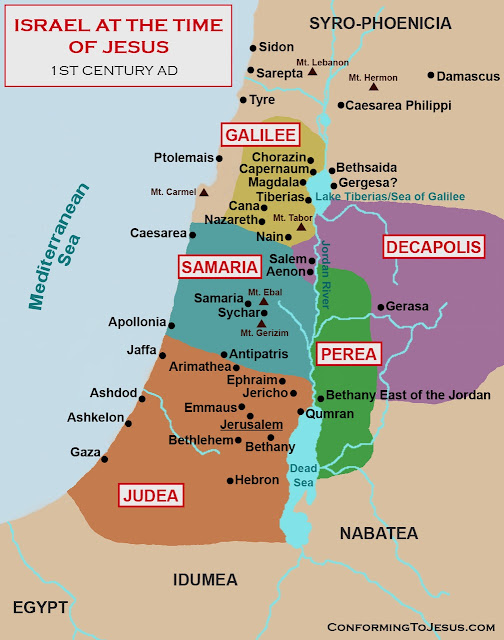
Samaritans were among various conquered peoples who in the 8th century BCE had been deported by the king of Assyria as immigrants to colonize Samaria—first the name of a city and then of a territory north of the southern kingdom of Judea.

Though both Samaritans and Judeans claimed descent from Abraham and Sarah, it was common for Judeans to regard Samaritans as foreigners, as outsiders. This antagonism was grounded in different languages, different temple sites, differing ritual requirements, differing versions of scripture, and competing claims to land. These differences resulted in mutual suspicion, ostracism, and outright hostility.

Gospel Texts

We see volatile antagonism towards Samaritans among Jesus's own disciples:

When the days drew near for him to be taken up, he [Jesus] set his face to go to Jerusalem. And he sent messengers ahead of him. On their way they entered a village of the Samaritans to make ready for him; but they did not receive him, because his face was set toward Jerusalem. When his disciples James and John saw it, they said, "Lord, do you want us to command fire to come down from heaven and consume them?" But he turned and rebuked them. Then they went on to another village. (Luke 9.51–56, New Revised Standard Version)

Jesus rebukes his hot-headed disciples and avoids confrontation by simply trying a different village.

Poor James and John! They were likely aware of the scriptural story in which the prophet Elijah called down fire from heaven—twice in quick succession—to consume a hundred and two soldiers of the Israelite king who was reigning in Samaria (2 Kings 1.9–12). Jesus was being widely regarded as a prophet. Wouldn't it be a good idea for him to call down fire on these inhospitable Samaritans!

We can understand Jesus's recurring, weary laments addressed to his disciples: "Are you still without understanding?" (Matthew 15.16; see also Mark 4.13; 6.52; 7.18; 8.17; 8.21; 9.32; Luke 9.45).

When Jesus sends out his twelve apostles—without him, on their own—to minister to spiritual and physical needs of the populace, he gives them careful instructions for avoiding confrontation:

These twelve Jesus sent out with the following instructions: "Go nowhere among the Gentiles, and enter no town of the Samaritans, but go rather to the lost sheep of the house of Israel." (Matthew 10.5-7)

As for Jesus himself, his interactions with Samaritans were amicable, as in this encounter sometimes known as "The Grateful Samaritan":

On the way to Jerusalem Jesus was going through the region between Samaria and Galilee. As he entered a village, ten lepers approached him. Keeping their distance, they called out saying, "Jesus, Master, have mercy on us!" When he saw them, he said to them, "Go and show yourselves to the priests." And as they went, they were made clean. Then one of them, when he saw that he was healed, turned back, praising God with a loud voice. He prostrated himself at Jesus' feet and thanked him. And he was a Samaritan. Then Jesus asked, "Were not ten made clean? But the other nine, where are they? Was none of them found to return and give praise to God except this foreigner?" Then he said to him, "Get up and go on your way; your faith has made you well." (Luke 17.11–19)

The most familiar of Jesus's parables is traditionally titled "The Good Samaritan":

A lawyer stood up to test Jesus. "Teacher, "he said, "what must I do to inherit eternal life?" He said to him, "What is written in the law? What do you read there?" He answered, "You shall love the Lord your God with all your heart, and with all your soul, and with all your strength, and your neighbor as yourself." And he said to him, "You have given the right answer; do this, and you will live."

But wanting to justify himself, he asked Jesus, "And who is my neighbor?" Jesus replied, "A man was going down from Jerusalem to Jericho, and fell into the hands of robbers, who stripped him, beat him, and went away, leaving him half dead. Now by chance a priest was going down that road; and when he saw him, he passed by on the other side. So likewise a Levite, when he came to the place and saw him, passed by on the other side. But a Samaritan while traveling came near him; and when he saw him, he was moved with pity. He went to him and bandaged his wounds, having poured oil and wine on them. Then he put him on his own animal, brought him to an inn, and took care of him. The next day he took out two denarii, gave them to the innkeeper, and said, "Take care of him; and when I come back, I will repay you whatever more you spend." Which of these three, do you think, was a neighbor to the man who fell into the hands of the robbers?" He said, "The one who showed him mercy." Jesus said to him, "Go and do likewise." (Luke 10.25–37)

By praising a Samaritan as exemplary while casting a shadow of shame upon two religious officials—a priest and a Levite—Jesus went beyond the pale for some of his compatriots. Perhaps Jesus's ecumenical largess lies behind this angry outburst from his antagonists:

"Are we not right in saying that you are a Samaritan and have a demon?" (John 8.48)

Thus labeled a Samaritan and accused of having a demon, Jesus denies demonism, but changes the subject and lets the charge of immigrant-sympathizer slide:

Jesus answered, "I do not have a demon; but I honor my Father, and you dishonor me." (John 8.49)

The Gospel of John provides an extensive account of an encounter between Jesus and Samaritans, devoting most of a chapter to Jesus's two-day stay in a Samaritan village. John's lengthy narrative includes extensive theological preachments, which I have abridged here to keep focus on Jesus/Samaritan interactions:

He [Jesus] left Judea and started back to Galilee. But he had to go through Samaria. So he came to a Samaritan city called Sychar.  ... Jesus, tired out by his journey, was sitting by the well. It was about noon.

A Samaritan woman came to draw water, and Jesus said to her, "Give me a drink." (His disciples had gone to the city to buy food.) The Samaritan woman said to him, "How is it that you, a Jew, ask a drink of me, a woman of Samaria?" (Jews do not share things in common with the Samaritans.) Jesus answered her, "Everyone who drinks of this water will be thirsty again, but those who drink of the water that I will give them will never be thirsty. The water that I will give will become in them a spring of water gushing up to eternal life." The woman said to him, "Sir, give me this water, so that I may never be thirsty or have to keep coming here to draw water."

Jesus said to her, "Go, call your husband, and come back." The woman answered him, "I have no husband." Jesus said to her, "You are right in saying, 'I have no husband'; for you have had five husbands, and the one you have now is not your husband. What you have said is true!" The woman said to him, "Sir, I see that you are a prophet. Our ancestors worshiped on this mountain, but you say that the place where people must worship is in Jerusalem...."

Just then his disciples came. They were astonished that he was speaking with a woman, but no one said, "What do you want?" or, "Why are you speaking with her?" Then the woman left her water jar and went back to the city. She said to the people, "Come and see a man who told me everything I have ever done! He cannot be the Messiah, can he?"

...Many Samaritans from that city believed in him because of the woman's testimony, "He told me everything I have ever done." So when the Samaritans came to him, they asked him to stay with them, and he stayed there two days....

When the two days were over, he went from that place to Galilee.... (John 4.3–40)

This affable interaction between Jesus and Samaritans should not lead us to think that Jesus was always pacific. Jesus was capable of anger and severe judgments, but we never find him criticizing Samaritans.

Most often Jesus's criticisms are directed toward hypocrisy among the religious elite. In chapter 23 of Matthew, for example, Jesus levels seven distinct accusations at religious leaders. One accusation begins with the exclamatory "Woe to you, blind guides...." The other six begin with "Woe to you, scribes and Pharisees, hypocrites!"

Each of Jesus's seven "woes" criticizes a specific domain of hypocrisy. Here is one of the seven in its entirety, critical of religious leaders who focus on picayune details of sacrificial offerings while neglecting their essential social and spiritual obligations:

Woe to you, scribes and Pharisees, hypocrites! For you tithe mint, dill, and cummin, and have neglected the weightier matters of the law: justice and mercy and faith. It is these you ought to have practiced without neglecting the others. You blind guides! You strain out a gnat but swallow a camel!" (Matthew 23.23–24)*


 Concluding Comparisons

Comparing Jesus's Samaritan interactions with present-day attitudes toward immigrants can go only so far. Differences will far outnumber similarities. Yet I believe that some specific comparisons deserve attention.

1) In Jesus's encounter with the ten lepers, the gospel narrative identifies the man who returned to thank Jesus as "a Samaritan." Jesus himself calls the man a "foreigner" (ἀλλογενής, allogenēs: "of another race"). This term significantly overlaps "immigrants" in our day. (Luke 17.18)

2) Jesus focuses on the better attributes of Samaritans, not on their worse. The parable of the Good Samaritan is certainly an example. We see another example in the conversation of Jesus and the Samaritan woman at the well. Jesus is somehow aware of the woman's history of five husbands and of her current co-habitation with a sixth man, but he does not make this an issue. Had he done so, the villagers might not have invited Jesus "to stay with them." (John 4.40)

3) The fire-from-heaven narrative that we considered above (Luke 9.51–56) opens with the phrase "he set his face to go to Jerusalem." Jesus would have been well aware that Samaritan tradition prohibited giving assistance to pilgrims who were on their way to what Samaritans considered the wrong temple—the temple in Jerusalem. The woman at the well points this out:

Our ancestors worshiped on this mountain [Mount Gerizim], but you say that the place where people must worship is in Jerusalem. (John 4.20)

Jesus responds, not with divisive geographical or denominational argument, but with words of spiritual transcendence:

God is spirit, and those who worship him must worship in spirit and truth. (John 4.24)

If we widen our view beyond Samaritans, we find that Jesus's healing ministry was thoroughly ecumenical and international. We read of Jesus ministering widely in Gentile territory.

(a) Jesus ministers among Gentile residents of the Decapolis (see map above), populated three centuries before New Testament times by "Greek-speaking immigrants,"** and Gentile-ruled by Romans during the time of Jesus's ministry. (Matthew 4.23–25; Mark 7.31–37)

(b) Jesus commends a persistent Gentile woman, a Canaanite, crying out "my daughter is tormented by a demon"—first ignored by Jesus, then fended off by the disciples, then greeted by Jesus dubiously, but in the end praised by Jesus: "Woman, great is your faith. Let it be done as you wish." (Matthew 15.21–28; Mark 7.24–30)

(c) Jesus is active in Gentile territory near the Sea of Galilee, where he ministers to "a man who had demons"—bound in chains and screaming. (Mark 5.1–20; Luke 8.26–39) Matthew reports that there were two demoniacs. (8.28–34)

(d) Jesus interacts with a Gentile centurion, a Roman citizen, whose plea to help his sick slave was rewarded with Jesus's commendation: "I tell you, not even in Israel have I found such faith." (Matthew 8.5–13; Luke 7.1–10)

Amidst the immigration crisis of our day, I believe that the words of Jesus concluding the parable of the Good Samaritan should be a guiding commission for all of us who call ourselves Christians: "Go and do likewise." (Luke 10.37)

*****

With Christ there is no east or west,
with Christ no south or north,
but one great healing fellowship
throughout the whole wide earth.

Join hands, disciples of all faiths,
what'er your race may be;
all children of the living God
are surely kin to me.

   ...John Oxenham, 1908, altered

 ____________

*We get a glimpse of the complex tradition of temple tithing in the biblical book of Numbers, 18.21–32.

**Mercer Dictionary of the Bible, ed. Watson E. Mills, Mercer University Press, 1990, "Decapolis," p.206.

*****

Friday, August 28, 2020

Appreciation: A Gentle Virtue


Lists of Virtues

Recently our nation's public expressions of appreciation for first responders and medical workers have led me to wonder why appreciation is not included in traditional lists of virtues.

Let me share some thoughts about this, and offer some suggestions in support of appreciation as a virtue.

Virtue is defined in various ways. I think of a virtue as a quality of character and conduct that makes for  good.*

Tradition has provided us with many lists of virtues. Socrates listed justice, liberality, courage, temperance, and truthfulness. Thomas Aquinas listed prudence, justice, temperance, justice, fortitude, faith, hope, and love. Benjamin Franklin assembled long lists of virtues including justice, frugality, and sincerity.

Traditional lists like these express virtues as nouns.

Scouts list their virtues in a different form. 
   
The Boy Scout Law 

A Scout is
   trustworthy
   loyal
   helpful
   friendly
   courteous
   kind
   obedient
   cheerful
   thrifty
   brave
   clean and
   reverent.

Here virtues are expressed as adjectives.

The Girl Scout Law

I will do my best to be
   honest and fair,
   friendly and helpful,
   considerate and caring,
   courageous and strong, and
   responsible for what I say and do,
and to
   respect myself and others,
   respect authority,
   use resources wisely,
   make the world a better place, and
   be a sister to every Girl Scout.

Girl Scouts express their law with verbals—the infinitive to be plus adjectives ("to be honest...")  and with additional infinitives plus objects ("to respect myself and others...)."

It is instructive to compare the differing grammars of these three styles of listing

In the traditional lists of virtues, the nouns—"prudence, "justice..."—are reified and static, abstract and distant.

In contrast, the adjectival virtues of the Boy Scout listing—"trustworthy, loyal..."—are more dynamic and humane.

The Girl Scout listing is personalized ("I will do my best to be..."), confessional ("responsible for what I say and do"), and energizing ("make the world a better place"). Its verbal phrases are vital pledges: "to respect"; "to use"; "to make."

The traditional virtues are all limited by a significant deficiency. With the exception of hope and love, the traditional virtues are without verbal forms. We cannot say "to prudence" or "to justice." But appreciation has the verbal form to appreciate, and this infuses the word with energy.

Certainly a Boy Scout might pledge to be appreciative—an adjective.

But I think that appreciation might find its most cordial welcome among the infinitives and adjectives of a pledge like the Girl Scout Law. As a possible example:

      ...and to
            respect myself,
            appreciate others,
            respect authority,
            etc.

Appreciation as a Virtue

With so many lists of virtues in existence—far more numerous than the three lists I've chosen to mention  here—what might appreciation add?

Appreciation is richer in meanings than we usually pause to consider. The Oxford English Dictionary includes a range of distinct meanings. To appreciate may be

1) to register or take notice: "The brain's occipital lobe appreciates the influence of light upon the retina." 

2) to understand or discern: "Napoleon, appreciating the magnitude of the danger, reigned his horse about."

3) to enhance or elevate: "The price of gold appreciated in today's metals markets."

4) to be grateful for: "I appreciate your kindness."

5) to evaluate or assess: "I appreciate the sacrifice your kindness has cost you." 

We usually associate appreciation with only the final two of these five meanings. In doing so we tend to think of appreciation not as a virtue but as simply good manners. 

All five meanings together, however, can broaden and deepen the concept of appreciation. In particular, I would include appreciation among Christian virtues, which can be illustrated by stories from Jesus's ministry.

1) Jesus takes notice, appreciating needs that are easily overlooked: 

A woman seeking healing "had heard about Jesus and came up behind him in the crowd and touched his cloak, for she said, 'if I but touch his clothes, I will be made well.'  Immediately her hemorrhage stopped; and she felt in her body that she was healed of her disease. Immediately aware that power had gone forth from him, Jesus turned about in the crowd and said, 'Who touched my clothes?' And his disciples said to him, 'You see the crowd pressing in on you; how can you say, "Who touched me?"' But the woman, knowing what had happened to her, came in fear and trembling, fell down before him , and told him the whole truth. He said to her, 'Daughter, your faith has made you well; go in peace, and be healed of your disease.'" (Mark 5:25–34; also Matthew 9:20–22 and Luke 8:43–48)

2) Jesus is discerning, untangling complex ethical issues:

John said to him, "Teacher, we saw someone casting out demons in your name, and we tried to stop him." But Jesus said, "Do not stop him; for no one who does a deed of power in my name will be able soon afterward to speak evil of me. Whoever is not against us is for us." (Mark 9:38–41; also Luke 9:49–50)  

3) Jesus enhances by elevating humility above presumptions of superiority:

At that time the disciples came to Jesus and asked, "Who is the greatest in the kingdom of heaven?" He called a child, whom he put among them, and said, "Truly I tell you, unless you change and become like children, you will never enter the kingdom of heaven. Whoever becomes humble like this child is the greatest in the kingdom of heaven." (Matthew 18:4; also Mark 9:33–36 and Luke 9:46–48.

4) Jesus is grateful, giving thanks and sharing with others:

He took the seven loaves, and after giving thanks he broke them and gave them to his disciples to distribute; and they distributed them to the crowd. They had also a few small fish; and after blessing them, he ordered that these too should be distributed. (Mark 8:6–7; also Matthew 15:36)

5) Jesus assesses and evaluates the cost of discipleship:

Peter said, "Look, we have left our homes and followed you." And he said to them, "Truly I tell you, there is no one who has left house or wife or brothers or parents or children, for the sake of the kingdom of God, who will not get back very much more in this age, and in the age to come eternal life." (Luke 18:28–30; also Mark 10:28-31)


A Gentle Virtue


Over the ages, various philosophical and theological traditions have paired lists of classic virtues with lists of opposing vices: liberality vs. greed; humility vs. pride; and so on. These pairings have never proved consistent or convincing. What the pairings have done, unfortunately, is to frame traditional virtues in terms of stark oppositions.

Our nation is currently acting out these kinds of stark opposition in street demonstrations: right/wrong; true/false; either/or.

We have a welcome exception to these expressions of stark opposition, however, in our public demonstrations of appreciation for frontline workers struggling to subdue COVID-19. These demonstrations of appreciation provoke no opposing demonstrations. Appreciation is a gentle virtue, taking the form of the poster pictured above, rather than storms of stones versus phalanxes of shields. By "gentle" I mean minimally argumentative.

But not all is peace and simplicity. The word "police" on the poster, for example, can give rise to argument and take on a divisive life of its own. Do we demand justice for police or justice for minorities?

To acknowledge specific disagreements does not discredit appreciating. This gentle virtue must be thoughtful, taking careful notice of difficulties; trying to discern possible responses; enhancing chances for peaceable resolution of differences; being grateful for the Mom-and-son poster, at the same time recognizing both the courage and the controversy the poster can represent. In short, we should take care to appreciate appreciation.

In situations of social conflict, we must not expect too much from appreciation. A gentle virtue cannot be expected to disperse street violence, but it can serve as a leaven. Daisies inserted into rifle barrels have been known to exert a calming effect.

On the personal level, it seems to me that words and acts of appreciation seldom result in opposition or disagreement. Appreciative words and acts are virtuous, expressing qualities of character and conduct that make for good.

The biblical book of Proverbs is a thirty-chapter cloudburst of traditional virtues versus vices. For example:

When pride comes, then comes disgrace;
   but wisdom is with the humble.
The integrity of the upright guides them,
   but the crookedness of the treacherous destroys them.
Riches do not profit in the day of wrath,
   but righteousness delivers from death. (Proverbs 11:2–4)

But squarely in the center of this book of dichotomies we find a quiet aphorism:

A gentle answer turns away wrath,
but a harsh word stirs up anger. (Proverbs 15:1)

I believe that in the midst of our harshly stirred-up culture, "We appreciate you" expresses a virtue—gentle, but with power to turn away wrath.


*****

__________

* I'm indebted here to Daniel Harrington and James Keenan, Jesus and Virtue Ethics (Rowman & Littlefield, 2002), p.23.

Monday, July 20, 2020

"Sure on this Shining Night": Origins and Meanings


Morten Lauridsen's 2005 choral composition "Sure on this Shining Night" sets to music several lines of a James Agee poem published in 1934. Performers, audiences, and listeners have warmly embraced this lovely marriage of lyric and music.


Among a host of recordings by professional, amateur, and youth choruses, I especially admire the recording by the Minnesota Chorale Artists, with Lauridsen at the piano: < https://bit.ly/2AxnpoQ >.

Sure on this shining night
Of starmade shadows round,
Kindness must watch for me
This side the ground.

The late year lies down the north.
All is healed, all is health.
High summer holds the earth.
Hearts all whole.

Sure on this shining night I weep for wonder wandering far alone 
Of shadows on the stars.
A number of commentators have called these ten lines "an untitled poem by James Agee." This is misleading. The lines are actually excerpts from a longer poem by Agee. A web posting by Debi Simons, 10/25/15, acquainted me with the fact that the lyric is "ripped from the middle of a longer Agee poem titled 'Description of Elysium'."

"Ripped" is a strong word; I prefer "excerpted" or "extracted." But I fully understand Simons' point: it seems unfair to lift and isolate ten congenial lines from a poem of forty-six lines, when the final sixteen lines of that poem are somber in the extreme.

Presumably the ten-line extraction was made by the composer Samuel Barber, who in 1940 set the words for solo voice and piano in what soon became a beloved art song titled "Sure on this Shining Night."* I've found no evidence that that Agee had any part in excerpting the text or naming the song. Agee and Barber first met in 1947, and they became good friends. Barber wrote "I met with him last week and admired him," and later recalled "I used to have lunch with him once every two weeks or so."**

The entire "Description of Elysium" was included in the volume of Agee poems titled Permit Me Voyage, published in 1934 by Yale University Press. Here is the complete poem, to which I have added section numbers in brackets to keep us oriented.
     "Description of Elysium"
 [Section 1]
Whole health resides with peace,
Gladness and never harm,
There not time turning,
Nor fear of flower of snow
Where marbling water slides
No charm may halt of chill,
Air aisling the open acres,
And all the gracious trees

Spout up their standing fountains
Of wind-beloved green
And the blue conclaved mountains
Are grave guards
Stone and springing field
Wide one tenderness,
The unalterable hour
Smiles deathlessness:

No thing is there thinks:
Mind the witherer
Withers on the outward air:
We can not come there.
[Section 2]
Sure on this shining night
Of starmade shadows round,
Kindness must watch for me
This side the ground.

The late year lies down the north.
All is healed, all is health.
High summer holds the earth.
Hearts all whole.

Sure on this shining night I weep for wonder wandering far alone 
Of shadows on the stars.
[Section 3] 
Now thorn bone bare
Silenced with iron the branch's gullet:
Rattling merely on the air
Of hornleaved holly:

The stony mark where sand was by
The water of a nailèd foot:
The berry harder than the beak:
The hole beneath the dead oak root:

All now brought quiet
Through the latest throe
Quieted and ready and quiet:
Still not snow:

Still thorn bone bare
Iron in the silenced gully
Rattling only of the air
Through hornleaved holly.
Section 1 of "Description of Elysium" characterizes the timeless realm of the blessed dead: "Whole health resides with peace, / Gladness and never harm...." Agee yearned for such innocence, but was profoundly disturbed by human failures, including his own.

Section 2 expresses the poet's response to a night of marveling inspiration: "Sure on this shining night / Of starmade shadows round...." Composer Lauridsen has described this moment of respite amidst human folly as "the wondrous awe that one has being within nature."***

Section 3 introduces menacing apocalyptic imagery: "Now thorn bone bare...of hornleaved holly." Agee wrestled with his harrowing premonition that "Pride, a mortal sin, can quite as coldly and inevitably damage and wreck the human race as the most total power of ‘Greed’ ever could."

The final two lines of Section 2 have generated a great deal of discussion:
Sure on this shining night I weep for wonder wandering far alone 
Of shadows on the stars.
What do the enigmatic phrases "weep for wonder," "wandering far alone," and "shadows on the stars" convey? Are the phrases ominous? Are they transcendent? Are they simply inscrutable? 

I have long been undecided about whether the concluding couplet of Section 2 expresses hope or despair or enigma, and have found Agee's phrase "shadows on the stars" completely puzzling. But I think I have some new light to shed.

Several singers and listeners have told me that the final couplet of "Sure on this Shining Night" seems to be a darkening transition into the bleak remainder of the larger poem. But in fact the larger poem has no such transitions.

Section 1 ends with the absolutely exclusionary words "We can not come there." Section 3 begins abruptly with bleak new imagery of "hornleaved holly." In between, Section 2 is quite distinct—not transitional but entire.

Allow me a personal observation. A few years ago a hornleaved holly sprang up volunteer in my little patch of garden. The official name is "Chinese Holly," Ilex cornuta. It is an escaped species, not native. Where it came from I do not know. One thing I do know—and this from bleeding experience—is that the horned leaves of Ilex cornuta make an impenetrable barrier:


My Horn Leaf Holly
Ilex cornuta

Still worse are the rigid, desiccated leaves of dead holly: 


Now thorn bone bare...
    Rattling merely on the air
Of hornleaved holly....

Given these barriers, I think we can say that we have three poems, joined only by mutual exclusion and a common title. "Sure on this Shining Night" finds itself between inaccessible innocence and goodness on the one hand, and quaking fear of self-destruction on the other. So, too, Agee finds himself, and the human race.

A few details from Laurence Bergreen's exemplary biography, James Agee: A Life, have further convinced me that Section 2 is coherent and expresses Agee's transcendent, spiritual experience.

Bergreen informs us that in 1930, the summer before Agee's junior year at Harvard, he was introduced to the household of Arthur Percy Saunders and Louise Brownell Saunders of Clinton, New York. The Saunders family quickly embraced young Agee, and the fondness was mutual.

Agee wrote to his mentor and life-long friend, Father James Flye: "They're the most beautiful and happy family to know and watch I've ever seen. It's hard to write of such people without becoming mawkish." At summer's end he wrote to Louise, "I've been homesick ever since I left you, and the last time I was homesick, I was nine years old." Agee and one of the Saunders daughters, Olivia or "Via", were mutually attracted and married in 1933.

Bergreen reports that Agee "roamed the large Saunders home at will, pausing to amuse himself with the professor's powerful telescope, through which Agee gazed at shivering images of the moon and the rings of Saturn." Bergreen describes the Saunders family as "blessed with enough money and intelligence to live exceedingly well." Also he reports that the father was a scientist, a retired professor of chemistry at Hamilton College. I think it fair to assume that the Saunders' telescope was a good one.

Again a personal note. In my senior year of high school I ground a six-inch mirror and mailed it off to be silvered—or in Agee's own terminology, "quicksilvered" ("The Truce", 1931). Upon its return I mounted the mirror in a tube with a secondary mirror and focusing lens. The magnification was good, but the telescope was limited in performance by the unsteadiness of my homemade tripod.

When all was completed I climbed at night to a dark hilltop. I focused first on the moon. The detail was stunning but not deeply engaging. Then I focused on Saturn. The tawny image of perfect, ringed symmetry suspended in prodigious darkness and absolute silence caught my breath and brought tears to my eyes.

It is probable that the Saunders telescope resolved detail beyond the capacity of mine. In particular, it might have disclosed the phenomenon of Saturn's shadow upon its rings, and the rings' shadows upon Saturn's surface. With amateur telescopes, seeing this phenomenon usually requires repeated viewings over long periods of time, as Saturn's position is constantly changing in relation to the locations of earth and sun. Also, earth's atmosphere must be at its clearest.

We know that the Saunders' father, called by his middle name Percy, did view the stars repeatedly. A biographer of the family writes:
He lectured, it is true, in chemistry, but through his warm personality he was able to come in close touch with many students. They shared his interest in music, art, literature, drama. On clear nights they could gather with him in the fields and explore the heavens through his telescope.****
In the practiced hands of Percy the 1930 telescope might well have resolved the Saturn shadows.


Telescopic View of Saturn from Earth
Here the sun is behind the viewer, below and slightly to the right. We glimpse part of Saturn's shadow on the rings as the small black interruption of the rings immediately above the sphere, slightly to the left. The shadow cast by the rings onto Saturn's surface is the very faint pinkish band, parallel to the rings, about a third of the way between the rings and the top of the planet's sphere.
I think that Agee might have included the phrase "shadows on the stars" in his verse as a kind of nod to his generous host through whose telescope he had shared views of Saturn's shadows. (I'm assuming that that Agee chose to use the poetic-licensed "stars" instead of the literal but clomping "planets.") The family biographer describes Percy as "a unique, incredible being. And yet he moved among us so simply with that quiet amused charm of his, unaware that he was in any way set apart from the rest of us." We are also told that Percy had an interest in literature. Agee's future father-in law seems a person likely to appreciate his clandestine reference in verse to shared experience.

There's a similar puzzle in the second stanza of Section 3. The phrase "a nailèd foot" has seemed to me impossibly obscure. Now I have learned from Bergreen that in the summer of 1930, Agee "was forced to hobble about on one foot, the painful result of inadvertently stepping on a nail." So I think phrase may be another in-family wink and nod—"nailèd foot" both describing Agee's summertime injury and also reinforcing Section 3's recurring theme of "thorn bone bare."

Two thirds of a century later, NASA launched its Cassini spacecraft to explore Saturn and its rings and moons. Here are two Cassini images:


Sunlight  coming from the right;
planet's shadow falling to the left.


Sun coming from the lower right;
Saturn's horizontal rings near the bottom;
surface shadows of the rings at upper left.


Percy and Agee were never to see such stunning images. But Agee and NASA share a sense of wonder. In a NASA report titled Ten Things: Why Cassini Mattered, the tenth item is this: "Cassini revealed the beauty of Saturn, its rings and moons, inspiring our sense of wonder." Wonder makes additional appearances in the report: "For more than a decade, NASA's Cassini spacecraft shared the wonders of Saturn." And "Cassini revealed in great detail the true wonders of Saturn."

Wonders of astronomy were often in Agee's thoughts. To Father Flye he suggests that body and mind are "like binary stars." His poem, "A Nursery Rhyme" (1937), compares "nebulae" to "the blown seeds of a dandelion," and seems to refer to the possibility that other galactic intelligence may be observing us:
Our galaxy, so runs the hope,
Is mirror for a telescope.
It is important to acknowledge that when the word shadow appears throughout Agee's writings, more often than not it serves as a metaphor for death. Here are two of many examples:
So, for a space, the Shadow will relent,
Befooling us with slow yet sure consent:
And, in due time, once more it will return,
Coolly to blot out what once more must burn.
                       ..."The Shadow" (1930)
How God must grieve, 
Watching in all this shadow land
The flinching vigil candles of this countless loss
In night’s nave each a life.
                       ...Letter to Father Frye, March 29, 1945
In Section 2, however, I believe that "shadows of the stars" evokes not death but Agee's living wonderment at his sheer existence in a vast cosmos graced with the delicacy of Saturn's shadows.

I am often unable to penetrate Agee's turgid poetry. So I feel fortunate that we have a prose account of an experience of wonder under the sky as sensed by a young boy. It comes from Agee's novelette, The Morning Watch, published when he was forty-two. Agee names his central character Richard, but the novel is obviously rooted in autobiographical recollections of Agee's experiences at St. Andrew's Episcopal School, 1919–1924, when Agee was in his early teenage years.

Young Richard and some of his classmates break rules by slipping outside after lights-out;
For the first time this year, he felt the ground against the bare soles of his feet.... Even though the ground in this schoolyard was skimmed with dusty gravel, its aliveness soared through him like a sob and lifted his eyes in wonder upon the night. There was no moon and what few stars were out, they were made faint by a kind of smiling universal milky silence, not fog, or even the lightest kind of mist, but as if the whole air and sky were one mild supernal breath.
 Agee portrays Richard in attendance at the St. Andrew's Good Friday service:
His heart opened. Almighty and everlasting God, he prayed, Maker of all things, Judge of all men (and he saw as in a wheeling rondure the shining of all things, the shadows of all men)....
I think we've no reason to doubt Agee's weeping for wonder beneath the rondure of stars, suspended in what he calls "space and darkness of sky beyond conjecture" ("Dedication", 1934).

We have one further detail of "Sure on this Shining Night" to consider: the phrase, "wandering far alone."

By all accounts, Agee was throughout his life an ebullient socializer, talking far into the night with enraptured comrades, male and female. Yet in matters of the "binary stars" of mind and soul he suffered increasing solitude. A simile Agee uses in The Morning Watch could well apply to himself: "lonesome as nebulae."

Agee was profoundly motivated by Christian morality. John Hersey speaks of his "enormous humanity and pity and sorrow." Adam Kirsch speaks of Agee's "desperate sincerity and fearful compassion." Robert Fitzgerald, Agee's close friend from Harvard days, writes, "For poverty and misery in general he had a sharp-eyed pity. Yet 'Church' and 'organized religion' in relation to awe and vision bothered his mind."

Agee attended Christian worship. At Harvard he frequented the Cowley Fathers Monastery (Anglo-Catholic) near Harvard Square, assisting as a server in the Mass. He sang in an octet at First Church (Congregational) Cambridge. Later, he and Via went to Anglo-Catholic Confession and partook of the Lord's Supper. They were married in a traditional Episcopal service.

Dwight Macdonald, Agee's friend since St. Andrew's days, spares no words:
Although he was deeply religious, he had his own kind of religion, one that included irreverence, blasphemy, obscenity, and even communism (of his own kind). By the late forties, a religio-conservative revival was under way, but Agee felt as out of place as ever...always out of step.
 MacDonald's words are borne out by Agee's self-description:
I have a religious background and am 'pro-religious'—though not on the whole delighted by this so-called revival—but doubt that I will return to religion.
In 1938, Agee, age 29, wrote to Father Flye, "I trust nothing else save a feeling of God, and love, and in part myself...." 

In 1945, age 36, he wrote to Flye:
It seems unlikely that I will ever become fully religious or a communicant again. But I hope I need not tell you, and feel sure you will not scorn, how grateful I am for such religious feelings as I do have. ...I have to doubt so much that at the same time I trust: thoughts and realizations mixed with personal and historic memories and projections so fill me with tears, and with faith and certainty, that it seems incredible to me not to be a Christian and a Catholic in the simplest and strictest senses of the words. But I am at once grateful for the emotions and doubtful of them.
 In 1950, age 40, five years before his death, Agee wrote to Father Flye:
I evidently move, as I imagine many people do, in a rough not very predictable cycle, between feeling relatively uninvolved religiously and very much involved: though I'm not sure that "religiously" is the right word for it: but anyhow a strong sense of being open, aware, concerned, in the ways which are rooted usually in religion, or in the more serious kinds of poetry or music, or just in a sense of existence—i.e. a relatively very full and emotionally rich sense of it, as compared with the opposite side of the cycle. I'm evidently swinging into it again now. At times or moments I feel virtually sure that nothing short of coming back into a formal religion (probably the one I was brought up in) will be nearly enough for me: at others, just as sure I never will. But at all times I feel sure that my own shapeless personal religious sense, whatever that may be, is deepening and increasing: even the swings away are less far away from it: keep some kind of religion with it. I wish I were with you and could talk about this, but even if I were I doubt there would actually be much to say about it...essentially a very private matter and should be....
In mind and soul, this most gregarious of poets felt himself solitary—"very private," "wandering far alone."


 CODA

Agee's lyric and Lauridsen's musical setting seem to me a perfect wedding. The flowing melodic lines and melting harmonic tensions—seconds and fourths, sevenths and ninths—convey tender warmth throughout.

Amidst the gentle harmonic tensions, the only sustained dissonance comes with the enigmatic words we have been considering:
I weep for wonder wand'ring far alone
of shadows on the stars.
Lauridsen asks the altos to sing a dissonant C ("far alone"?) and repeat that discordant note throughout three full measures. The dissonance is subtle but disquieting. Then the resolution of that dissonance on the concluding word, stars, is as heart-melting as any musical cadence I can call to memory.

In the recording linked at the beginning of this posting, listen for these three dissonant measures and their cadence at 2:43ff.


James Agee

__________

* Besides Barber and Lauridsen, a least two other composers, Mark Foster and Z. Randall Stroope, have published settings of "Sure on this Shining Night."

** I have included references for only a few of the quotations in this posting, trying to minimize what the literary critic Edmund Wilson has called "scholarly barbed wire." If anyone should want particular references, feel free to send me a request by e-mail (albertblackwell39@gmail.com) and I shall answer promptly.

*** Quoted by Margaret B. Owens, "Morten Lauridsen's Choral Cycle, Nocturnes; A Conductor's Analysis" (2019). < https://bit.ly/3j5fGzF >

**** Elsie M. Pomeroy, William Saunders and His Five Sons, The Ryerson Press – Toronto, 1956.


*****