Tuesday, April 6, 2021

Sayings of Mirth and Meaning and Maybe Both


Steeple and Paraglider
Lake Bohini, Slovenia

Since college days I have collected sayings that I find edifying and entertaining. My file contains scores of cards, dashed off with no concern for careful documentation and no thought of ever sharing—till now. As a result, the fifty sayings that I share here are often loosely documented or undocumented. I offer my thanks and, where necessary, my apologies to the originators.

~~~~~~~~~~ 

Vital religion is like good music: it needs no defense, only rendition. A wrangling controversy in support of religion is as if the members of an orchestra should beat folks over the head with their violins to prove that the music is beautiful. Play the music! (Rev. Harry Emerson Fosdick) 

~~~~~~~~~~ 

Church marquee: "Tithe. Anyone can honk." 

~~~~~~~~~~ 

A prig is a person whose opinions we always know, though we never ask.

~~~~~~~~~~ 

It is the part of wisdom not to bewail nor to deride, but to understand. (Benedict Spinoza, Ethics

~~~~~~~~~~ 

An Amish man is asked, "Are you saved?" He responds, "I'm not the one to ask. Ask people who know me." 

~~~~~~~~~~ 

Peace is not an end to differences; it is a way of dealing with differences. (Roger Fisher, Harvard Magazine, March-April 2004) 

~~~~~~~~~~ 

Confusion we can clear up. Mystery we cannot. Be clear, and revere mystery. (Scott Russell Sanders) 

~~~~~~~~~~ 

The best things in life are not things. 

~~~~~~~~~~

Don't believe everything you think. (Allan Lokos) 

~~~~~~~~~~

Our world neglects vastly too many people, leaving them to swallow their tears and live on the salt.

~~~~~~~~~~ 

Savoring the world and saving the world are profoundly connected. (E. B. White) 

~~~~~~~~~~ 

The Devil comes to a Legislator and says, "I can offer you unlimited special interest money, money impossible to trace; in return I ask for your soul and the souls of your children." The Legislator ponders for a moment and asks, "What's the catch?" 

~~~~~~~~~~ 

The only remedy for the irreversibility of history is forgiveness. (Hannah Arendt) 

~~~~~~~~~~ 

We must tangibilitate the Gospel. (Father Divine)

~~~~~~~~~~ 

To tell a lie is easy. To tell only one lie is difficult. 

~~~~~~~~~~ 

Reality is that which, when you don't believe in it, doesn't go away. (Peter Viereck) 

~~~~~~~~~~ 

This is grace: new chances in life. (Rev. Hans Küng, On Being a Christian

~~~~~~~~~~ 

What right have you to be scornful, whose virtue is but a deficiency of temptation. (William Makepeace Thackeray, Vanity Fair

~~~~~~~~~~ 

Seven Social Sins:

    Wealth without works
    Pleasure without conscience
    Knowledge without character
    Commerce without morality
    Science without humanity
    Worship without sacrifice
    Politics without principle

(From a sermon by Rev. Frederick Lewis Donaldson, Westminster Abbey, March 20, 1925; promulgated by Mahatma Gandhi.) 

~~~~~~~~~~ 

We must build that kind of society where it is easier for people to be good. (Peter Maurin, often quoted by Dorothy Day) 

~~~~~~~~~~ 

As far as I can tell, the only time Jesus wants people in the closet is when they are praying. (Rev. Dan Ivins, referring to Matthew 6:6) 

~~~~~~~~~~ 

A text out of context becomes a pretext. (Rev. Jesse Jackson) 

~~~~~~~~~~ 

The Church should comfort the afflicted and afflict the comfortable. (Adapted by Martin Marty from a saying about newspapers.) 

~~~~~~~~~~ 

Cowardice asks the question, is it safe? Expediency asks the question, is it politic? Vanity asks the question, is it popular? But conscience asks the question, is it right? And there comes a time when we must take a position that is neither safe, nor politic, nor popular, but we must take it because conscience tells us it is right. (Rev. Martin Luther King, Jr., speech at the Poor People's March in Washington DC, 1968)

~~~~~~~~~~ 

The trickle-down theory of economics is at variance with the prophetic message "Let justice roll down like waters, and righteousness like an ever-flowing stream." (Amos 5:24) 

~~~~~~~~~~ 

Fanaticism consists of redoubling your effort when you have forgotten your aim. (George Santayana, Life of Reason

~~~~~~~~~~

Liberal democracy must be more than just the Market plus elections, (Václav Havel) 

~~~~~~~~~~ 

O God, Protect me from your followers. (Bumper sticker) 

~~~~~~~~~~ 

The problem with much Christian mission work is that it's all mouth and no ears. (Prof. Diana Eck) 

~~~~~~~~~~ 

Christian discipleship: a realistic, reverent, reconciling life of service. 

~~~~~~~~~~ 

I wonder if Muslims look at us and think, "You're going to have to look a lot more redeemed before I'll believe in your redeemer." (Rev. William Willimon)

~~~~~~~~~~ 

A raindrop plunged in greyness may not know 
when God bends light within to make a bow. (Marian Willard Blackwell)

~~~~~~~~~~

Nobody cares how much you know until they know how much you care. (Teddy Roosevelt)

~~~~~~~~~~

We have to believe in free will. We have no choice. (Isaac Bashevis Singer) 

~~~~~~~~~~ 

A sense of mystery keeps strength gentle and certitude vulnerable. (John Dominic Crossan) 

~~~~~~~~~~

The problem with ideology: it does not represent or conform to or even address reality. It is a straight-edge ruler in a fractal universe. (Marilynne Robinson) 

~~~~~~~~~~ 

God does not die on the day when we cease to believe in a personal deity, but we die on the day when our lives cease to be illumined by the steady radiance, renewed daily, of a wonder, the source of which is beyond all reason. (Dag Hammarskjöld, Markings

~~~~~~~~~~ 

Being a pacifist between wars is like being a vegetarian between meals. (Ammon Hennacy) 

~~~~~~~~~~

Deal kindly with us, O Lord, deal kindly,
for we have suffered insult enough;
for too long have we had to suffer the insults of the wealthy,
the scorn of proud men. (Psalm 123:4–5, The New English Bible)

~~~~~~~~~~ 

We are not punished for our sins, but by them. (Elbert Hubbard) 

~~~~~~~~~~ 

I have always been thinking of the different ways in which Christianity is taught, and whenever I find one way that makes it a wider blessing than any other, I cling to that as the truest—I mean that which takes in the most good of all kinds and brings in the most people as sharers. It is surely better to pardon too much than to condemn too much. (George Eliot, Middlemarch

~~~~~~~~~~ 

Political activist and community organizer Virginia Walker Broughton was told by her husband "You need to stay home." She replied, "I've had a talk with God. God told me this is my calling. I have to do this. So you and God work this out." (Told by Prof. Evelyn Brooks Higginbotham in The Black Church, by Henry Louis Gates, Jr.) 

~~~~~~~~~~ 

We know that it is wrong to cheat, to steal, to lie; that people are precious in the sight of God and must always be treated as such; that manners matter; that kindness counts; that knowledge is superior to ignorance; and that the simplest courtesies are superior to the most sophisticated arguments. (Rev. Peter Gomes, welcoming service for new students, Harvard University Memorial Church) 

~~~~~~~~~~

A reporter asked Rev. Hoyt Blackwell, President of Mars Hill College, about rumors of friction among the faculty. He answered: "Yes, we have enough friction to give us traction." 

~~~~~~~~~~ 

We are of one heart but of two minds. (Rev. William Sloan Coffin, Jr. on discussions of homosexuality at New York's Riverside Church) 

~~~~~~~~~~ 

Several friends visited W. C. Fields at a sanatorium where he had gone after a bad binge. They were astounded to find him sitting up in bed reading the Bible. When they asked why he was reading that particular book, Fields replied: "Looking for loopholes." 

~~~~~~~~~~ 

Wisdom from the movies:

    "God loves you just as you are, and loves you too much to leave you that way." (Junebug

    "Sometimes we must just keep on living until we feel alive again." (Call the Midwife

    "Do your best each day, and see what tomorrow brings." (Riding the Bus with My Sister

    "Have courage and be kind." (Cinderella, 2015) 

~~~~~~~~~~ 

Wealth is not a sin, but it is a problem. (Rev. Peter Gomes, The New Yorker, 11/11/96) 

~~~~~~~~~~ 

Too often our Christian social ethics seems to extend little further than the maxim to leave the rented beach cottage as clean as we found it.

~~~~~~~~~~

What wisdom can you find that is greater than kindness? (Jean-Jacques Rousseau)


*****


Tuesday, October 6, 2020

Jesus and Immigrants


Agents with the US Border Patrol raided a faith-based humanitarian aid camp
for undocumented immigrants near the US-Mexico border on the evening of October 5—
the second action taken against the camp since July.
The raid on Byrd Camp was announced on Twitter by Roy Villareal, 
chief patrol agent for the Tuscon Sector, 
who referred to the camp derisively as a "so called Samaritan camp."
...Christian Century, November 4, 2020

Introduction

Antagonism toward immigrants, expressed today by many of our nation's citizens and leaders, bears some resemblance to hostility between Judeans and Samaritans as reflected in the Gospels of the New Testament. I think it is important for Christians to take particular note of relationships between Jesus and Samaritans.

Samaritans were among various conquered peoples who in the 8th century BCE had been deported by the king of Assyria as immigrants to colonize Samaria—first the name of a city and then of a territory north of the southern kingdom of Judea.

Though both Samaritans and Judeans claimed descent from Abraham and Sarah, it was common for Judeans to regard Samaritans as foreigners, as outsiders. This antagonism was grounded in different languages, different temple sites, differing ritual requirements, differing versions of scripture, and competing claims to land. These differences resulted in mutual suspicion, ostracism, and outright hostility.

Gospel Texts

We see volatile antagonism towards Samaritans among Jesus's own disciples:

When the days drew near for him to be taken up, he [Jesus] set his face to go to Jerusalem. And he sent messengers ahead of him. On their way they entered a village of the Samaritans to make ready for him; but they did not receive him, because his face was set toward Jerusalem. When his disciples James and John saw it, they said, "Lord, do you want us to command fire to come down from heaven and consume them?" But he turned and rebuked them. Then they went on to another village. (Luke 9.51–56, New Revised Standard Version)

Jesus rebukes his hot-headed disciples and avoids confrontation by simply trying a different village.

Poor James and John! They were likely aware of the scriptural story in which the prophet Elijah called down fire from heaven—twice in quick succession—to consume a hundred and two soldiers of the Israelite king who was reigning in Samaria (2 Kings 1.9–12). Jesus was being widely regarded as a prophet. Wouldn't it be a good idea for him to call down fire on these inhospitable Samaritans!

We can understand Jesus's recurring, weary laments addressed to his disciples: "Are you still without understanding?" (Matthew 15.16; see also Mark 4.13; 6.52; 7.18; 8.17; 8.21; 9.32; Luke 9.45).

When Jesus sends out his twelve apostles—without him, on their own—to minister to spiritual and physical needs of the populace, he gives them careful instructions for avoiding confrontation:

These twelve Jesus sent out with the following instructions: "Go nowhere among the Gentiles, and enter no town of the Samaritans, but go rather to the lost sheep of the house of Israel." (Matthew 10.5-7)

As for Jesus himself, his interactions with Samaritans were amicable, as in this encounter sometimes known as "The Grateful Samaritan":

On the way to Jerusalem Jesus was going through the region between Samaria and Galilee. As he entered a village, ten lepers approached him. Keeping their distance, they called out saying, "Jesus, Master, have mercy on us!" When he saw them, he said to them, "Go and show yourselves to the priests." And as they went, they were made clean. Then one of them, when he saw that he was healed, turned back, praising God with a loud voice. He prostrated himself at Jesus' feet and thanked him. And he was a Samaritan. Then Jesus asked, "Were not ten made clean? But the other nine, where are they? Was none of them found to return and give praise to God except this foreigner?" Then he said to him, "Get up and go on your way; your faith has made you well." (Luke 17.11–19)

The most familiar of Jesus's parables is traditionally titled "The Good Samaritan":

A lawyer stood up to test Jesus. "Teacher, "he said, "what must I do to inherit eternal life?" He said to him, "What is written in the law? What do you read there?" He answered, "You shall love the Lord your God with all your heart, and with all your soul, and with all your strength, and your neighbor as yourself." And he said to him, "You have given the right answer; do this, and you will live."

But wanting to justify himself, he asked Jesus, "And who is my neighbor?" Jesus replied, "A man was going down from Jerusalem to Jericho, and fell into the hands of robbers, who stripped him, beat him, and went away, leaving him half dead. Now by chance a priest was going down that road; and when he saw him, he passed by on the other side. So likewise a Levite, when he came to the place and saw him, passed by on the other side. But a Samaritan while traveling came near him; and when he saw him, he was moved with pity. He went to him and bandaged his wounds, having poured oil and wine on them. Then he put him on his own animal, brought him to an inn, and took care of him. The next day he took out two denarii, gave them to the innkeeper, and said, "Take care of him; and when I come back, I will repay you whatever more you spend." Which of these three, do you think, was a neighbor to the man who fell into the hands of the robbers?" He said, "The one who showed him mercy." Jesus said to him, "Go and do likewise." (Luke 10.25–37)

By praising a Samaritan as exemplary while casting a shadow of shame upon two religious officials—a priest and a Levite—Jesus went beyond the pale for some of his compatriots. Perhaps Jesus's ecumenical largess lies behind this angry outburst from his antagonists:

"Are we not right in saying that you are a Samaritan and have a demon?" (John 8.48)

Thus labeled a Samaritan and accused of having a demon, Jesus denies demonism, but changes the subject and lets the charge of immigrant-sympathizer slide:

Jesus answered, "I do not have a demon; but I honor my Father, and you dishonor me." (John 8.49)

The Gospel of John provides an extensive account of an encounter between Jesus and Samaritans, devoting most of a chapter to Jesus's two-day stay in a Samaritan village. John's lengthy narrative includes extensive theological preachments, which I have abridged here to keep focus on Jesus/Samaritan interactions:

He [Jesus] left Judea and started back to Galilee. But he had to go through Samaria. So he came to a Samaritan city called Sychar.  ... Jesus, tired out by his journey, was sitting by the well. It was about noon.

A Samaritan woman came to draw water, and Jesus said to her, "Give me a drink." (His disciples had gone to the city to buy food.) The Samaritan woman said to him, "How is it that you, a Jew, ask a drink of me, a woman of Samaria?" (Jews do not share things in common with the Samaritans.) Jesus answered her, "Everyone who drinks of this water will be thirsty again, but those who drink of the water that I will give them will never be thirsty. The water that I will give will become in them a spring of water gushing up to eternal life." The woman said to him, "Sir, give me this water, so that I may never be thirsty or have to keep coming here to draw water."

Jesus said to her, "Go, call your husband, and come back." The woman answered him, "I have no husband." Jesus said to her, "You are right in saying, 'I have no husband'; for you have had five husbands, and the one you have now is not your husband. What you have said is true!" The woman said to him, "Sir, I see that you are a prophet. Our ancestors worshiped on this mountain, but you say that the place where people must worship is in Jerusalem...."

Just then his disciples came. They were astonished that he was speaking with a woman, but no one said, "What do you want?" or, "Why are you speaking with her?" Then the woman left her water jar and went back to the city. She said to the people, "Come and see a man who told me everything I have ever done! He cannot be the Messiah, can he?"

...Many Samaritans from that city believed in him because of the woman's testimony, "He told me everything I have ever done." So when the Samaritans came to him, they asked him to stay with them, and he stayed there two days....

When the two days were over, he went from that place to Galilee.... (John 4.3–40)

This affable interaction between Jesus and Samaritans should not lead us to think that Jesus was always pacific. Jesus was capable of anger and severe judgments, but we never find him criticizing Samaritans.

Most often Jesus's criticisms are directed toward hypocrisy among the religious elite. In chapter 23 of Matthew, for example, Jesus levels seven distinct accusations at religious leaders. One accusation begins with the exclamatory "Woe to you, blind guides...." The other six begin with "Woe to you, scribes and Pharisees, hypocrites!"

Each of Jesus's seven "woes" criticizes a specific domain of hypocrisy. Here is one of the seven in its entirety, critical of religious leaders who focus on picayune details of sacrificial offerings while neglecting their essential social and spiritual obligations:

Woe to you, scribes and Pharisees, hypocrites! For you tithe mint, dill, and cummin, and have neglected the weightier matters of the law: justice and mercy and faith. It is these you ought to have practiced without neglecting the others. You blind guides! You strain out a gnat but swallow a camel!" (Matthew 23.23–24)*


 Concluding Comparisons

Comparing Jesus's Samaritan interactions with present-day attitudes toward immigrants can go only so far. Differences will far outnumber similarities. Yet I believe that some specific comparisons deserve attention.

1) In Jesus's encounter with the ten lepers, the gospel narrative identifies the man who returned to thank Jesus as "a Samaritan." Jesus himself calls the man a "foreigner" (ἀλλογενής, allogenēs: "of another race"). This term significantly overlaps "immigrants" in our day. (Luke 17.18)

2) Jesus focuses on the better attributes of Samaritans, not on their worse. The parable of the Good Samaritan is certainly an example. We see another example in the conversation of Jesus and the Samaritan woman at the well. Jesus is somehow aware of the woman's history of five husbands and of her current co-habitation with a sixth man, but he does not make this an issue. Had he done so, the villagers might not have invited Jesus "to stay with them." (John 4.40)

3) The fire-from-heaven narrative that we considered above (Luke 9.51–56) opens with the phrase "he set his face to go to Jerusalem." Jesus would have been well aware that Samaritan tradition prohibited giving assistance to pilgrims who were on their way to what Samaritans considered the wrong temple—the temple in Jerusalem. The woman at the well points this out:

Our ancestors worshiped on this mountain [Mount Gerizim], but you say that the place where people must worship is in Jerusalem. (John 4.20)

Jesus responds, not with divisive geographical or denominational argument, but with words of spiritual transcendence:

God is spirit, and those who worship him must worship in spirit and truth. (John 4.24)

If we widen our view beyond Samaritans, we find that Jesus's healing ministry was thoroughly ecumenical and international. We read of Jesus ministering widely in Gentile territory.

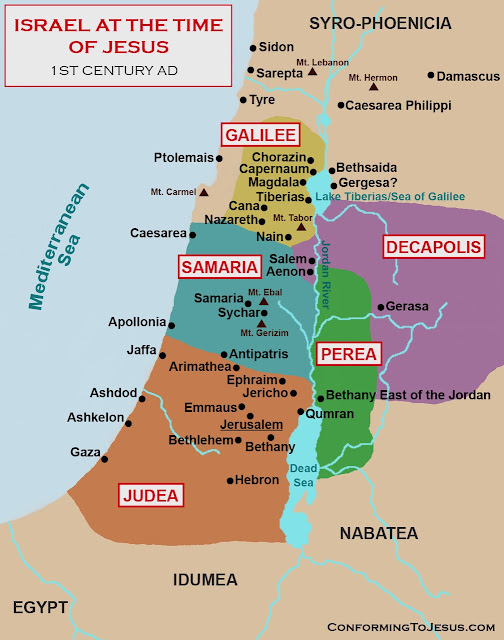
(a) Jesus ministers among Gentile residents of the Decapolis (see map above), populated three centuries before New Testament times by "Greek-speaking immigrants,"** and Gentile-ruled by Romans during the time of Jesus's ministry. (Matthew 4.23–25; Mark 7.31–37)

(b) Jesus commends a persistent Gentile woman, a Canaanite, crying out "my daughter is tormented by a demon"—first ignored by Jesus, then fended off by the disciples, then greeted by Jesus dubiously, but in the end praised by Jesus: "Woman, great is your faith. Let it be done as you wish." (Matthew 15.21–28; Mark 7.24–30)

(c) Jesus is active in Gentile territory near the Sea of Galilee, where he ministers to "a man who had demons"—bound in chains and screaming. (Mark 5.1–20; Luke 8.26–39) Matthew reports that there were two demoniacs. (8.28–34)

(d) Jesus interacts with a Gentile centurion, a Roman citizen, whose plea to help his sick slave was rewarded with Jesus's commendation: "I tell you, not even in Israel have I found such faith." (Matthew 8.5–13; Luke 7.1–10)

Amidst the immigration crisis of our day, I believe that the words of Jesus concluding the parable of the Good Samaritan should be a guiding commission for all of us who call ourselves Christians: "Go and do likewise." (Luke 10.37)

*****

With Christ there is no east or west,
with Christ no south or north,
but one great healing fellowship
throughout the whole wide earth.

Join hands, disciples of all faiths,
what'er your race may be;
all children of the living God
are surely kin to me.

   ...John Oxenham, 1908, altered

 ____________

*We get a glimpse of the complex tradition of temple tithing in the biblical book of Numbers, 18.21–32.

**Mercer Dictionary of the Bible, ed. Watson E. Mills, Mercer University Press, 1990, "Decapolis," p.206.

*****